Swipe through real skin spots. Learn which ones are worth a look.
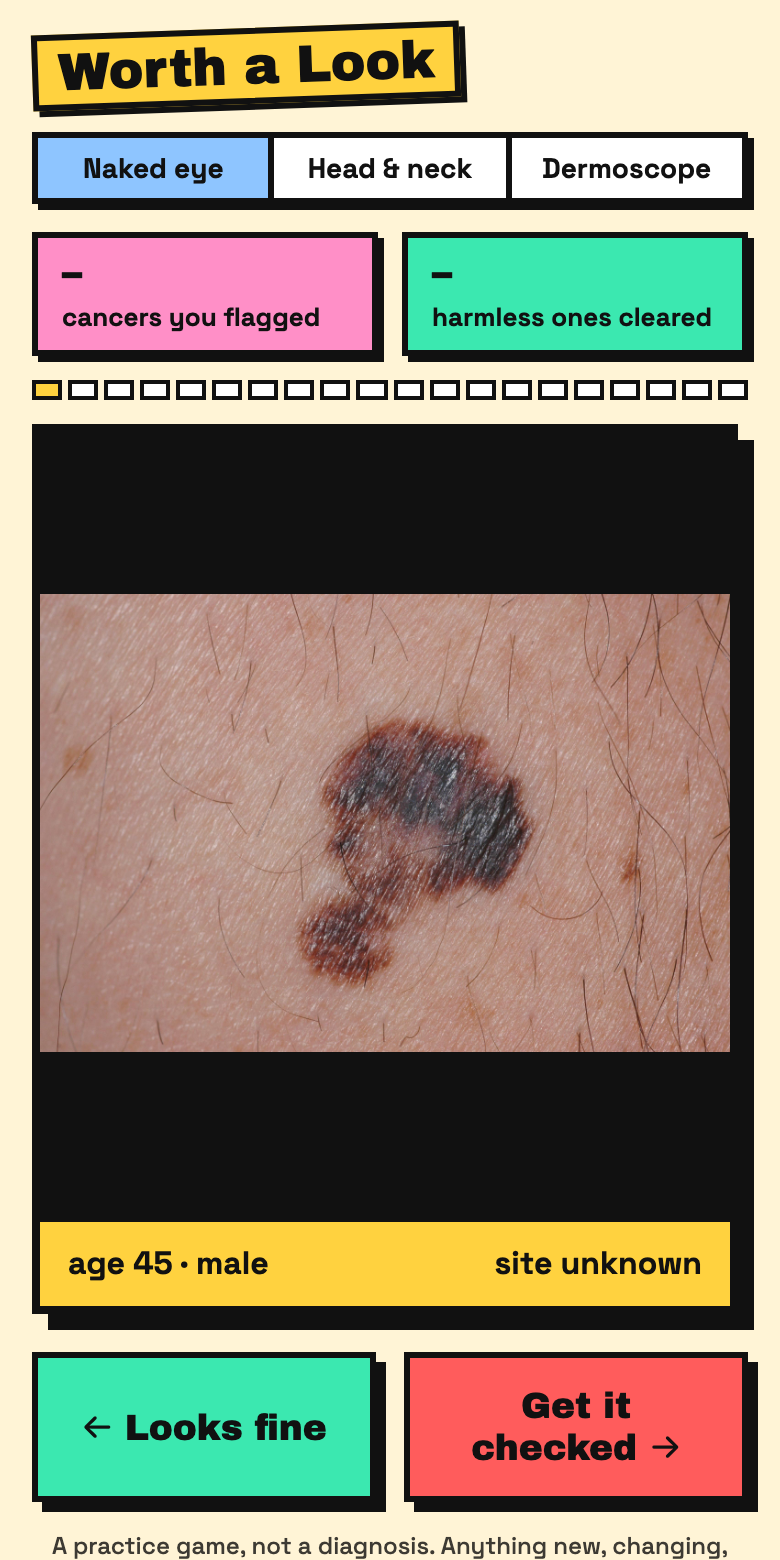
Worth a Look shows you real photos of moles and skin growths whose diagnosis is known, nearly all from a biopsy. You swipe left if it looks fine and right if you'd get it checked, and the real answer appears straight away. Each round is 20 photos and takes a few minutes.
Why this exists
Skin cancer is easier to treat when it's found early. People miss a lot on their own skin. One study puts it at about half of all melanomas, and the ones people miss are mostly on the scalp, head and neck, which are hard to see in a mirror.
Barbers, hairdressers and estheticians look at exactly those places, up close, every few weeks. Many already keep an eye out. Few have ever been taught what to look for, and most say they would like to learn.
Worth a Look is free practice for them, and for anyone else who wants to get better at noticing. The research is below.
They already notice
of scalp and neck melanomas treated at Emory's cancer center in Atlanta were first spotted by a hairdresser. Those patients were younger, 53 against 66, and their melanomas were more often caught at an early stage: 67% against 45%.
Lovasik et al., Annals of Surgical Oncology, 2016of 203 hair professionals in Houston had checked more than half their customers' scalps for suspicious spots in the past month. 29% did the same for necks, and 15% for faces.
Bailey et al., Archives of Dermatology, 2011of melanomas go unnoticed by the person themselves, mostly ones on the scalp, head and neck. A study of cosmetology students starts from this figure.
Radisic et al., Journal of Cosmetic Dermatology, 2020Few have been trained, and most want it
of those 203 Houston hair professionals had any formal skin cancer education. 49% were very or extremely interested in a training program.
Bailey et al., Archives of Dermatology, 2011of 37 UK hairdressers and barbers had any skin cancer awareness training. 92% said they would like some, or might.
Skin Health and Disease, 2025of 194 cosmetology students at seven Florida schools felt underprepared to check clients for unusual spots before a single skin cancer talk, and after it.
Radisic et al., Journal of Cosmetic Dermatology, 2020Training works
hair, skin and massage professionals in Oregon took an online course. Afterwards their level of concern for each spot matched doctors' ratings significantly better, and they felt more comfortable talking to clients about it.
Diehl et al., Journal of Cosmetic Dermatology, 2024estheticians took part in a training study. Those who had been on a skin cancer course before were more likely to suggest a client see a doctor, and after the training most felt very comfortable doing so.
Walker et al., Dermatology, 2024of 100 hairdressers felt very confident spotting melanoma after a 5-minute video. Correct answers on the warning signs rose from 59% to 71%.
Black et al., JAMA Dermatology, 2018correct for 36 medical students who practiced with a swipe app on photos of real spots, against 75% → 78% for students taught the usual way.
Lacy et al., JAMA Dermatology, 2018What was missing
A free place to practice.
Courses and videos teach the warning signs. We couldn't find anywhere free and open to see those signs on hundreds of real spots, with a known answer every time, a few minutes at a time between clients.
The medical students in the swipe-app study above practiced this way. Worth a Look offers that practice to anyone, built with barbers, hairdressers and estheticians in mind.
Try it →A review of 16 studies reached the same conclusion: these professionals are open to looking at the skin they already work on, and willing to send clients to a doctor when something looks wrong (Pearlman et al., 2021). Training programs already exist, among them Stylists Saving Lives, the Hairstylist Melanoma Challenge and a James Cook University program in Australia.
The job is to notice and suggest a doctor, never to diagnose. Head & neck mode shows a sentence for that after every cancer, such as: "I noticed a spot on your neck. Might be worth having a doctor look at it." For the chair itself there's a one-page spot checklist of what makes a spot worth a doctor's look.
One gap: the archive has very few scalp photos. Most head and neck photos are of the face, neck and ears.
How it works
Look
Each card is one real spot, with the person's age, sex and where it was on the body. Doctors use those too.
Swipe
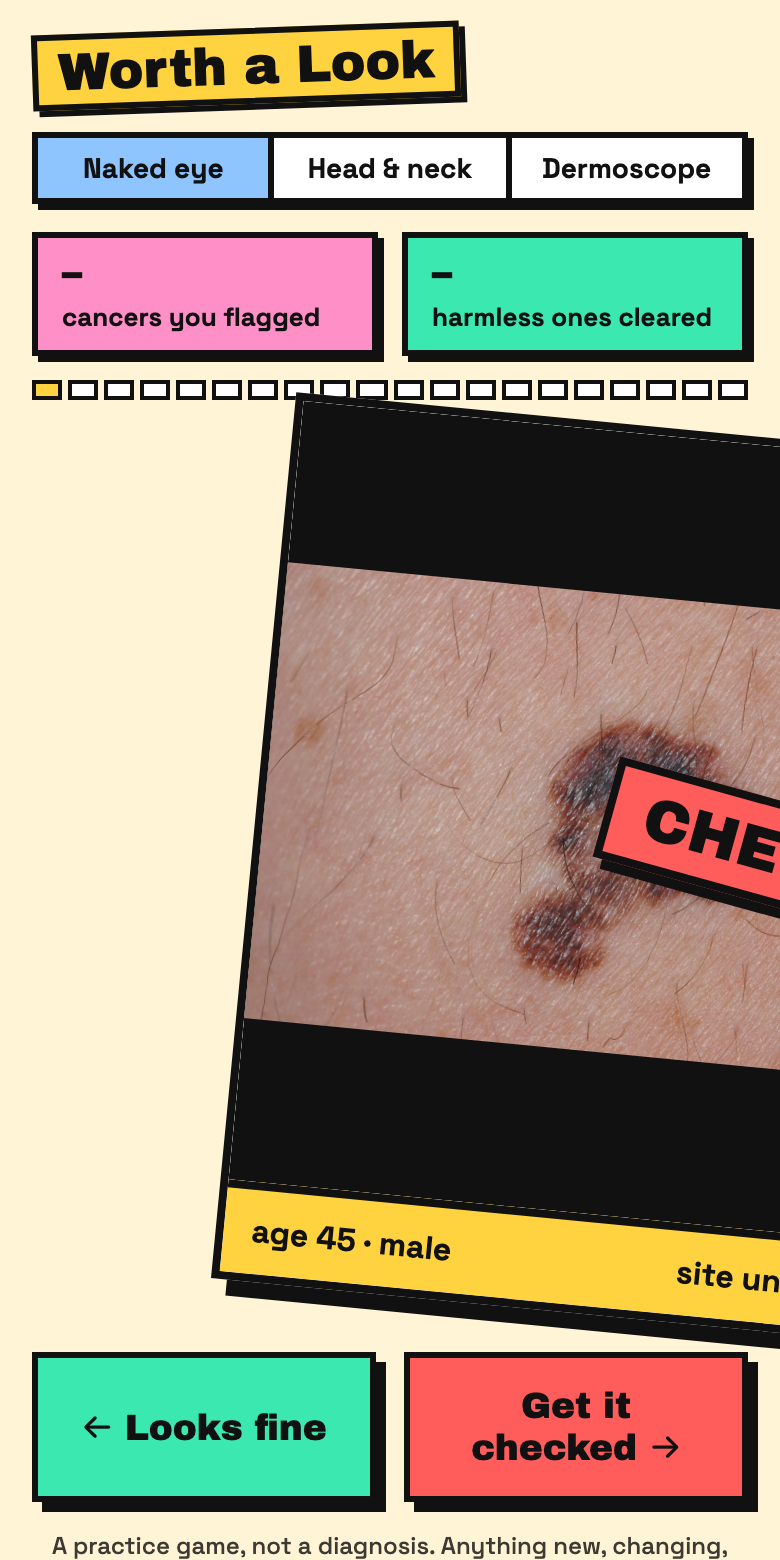
Left means it looks fine. Right means you'd get it checked. Buttons and arrow keys work as well.
Learn
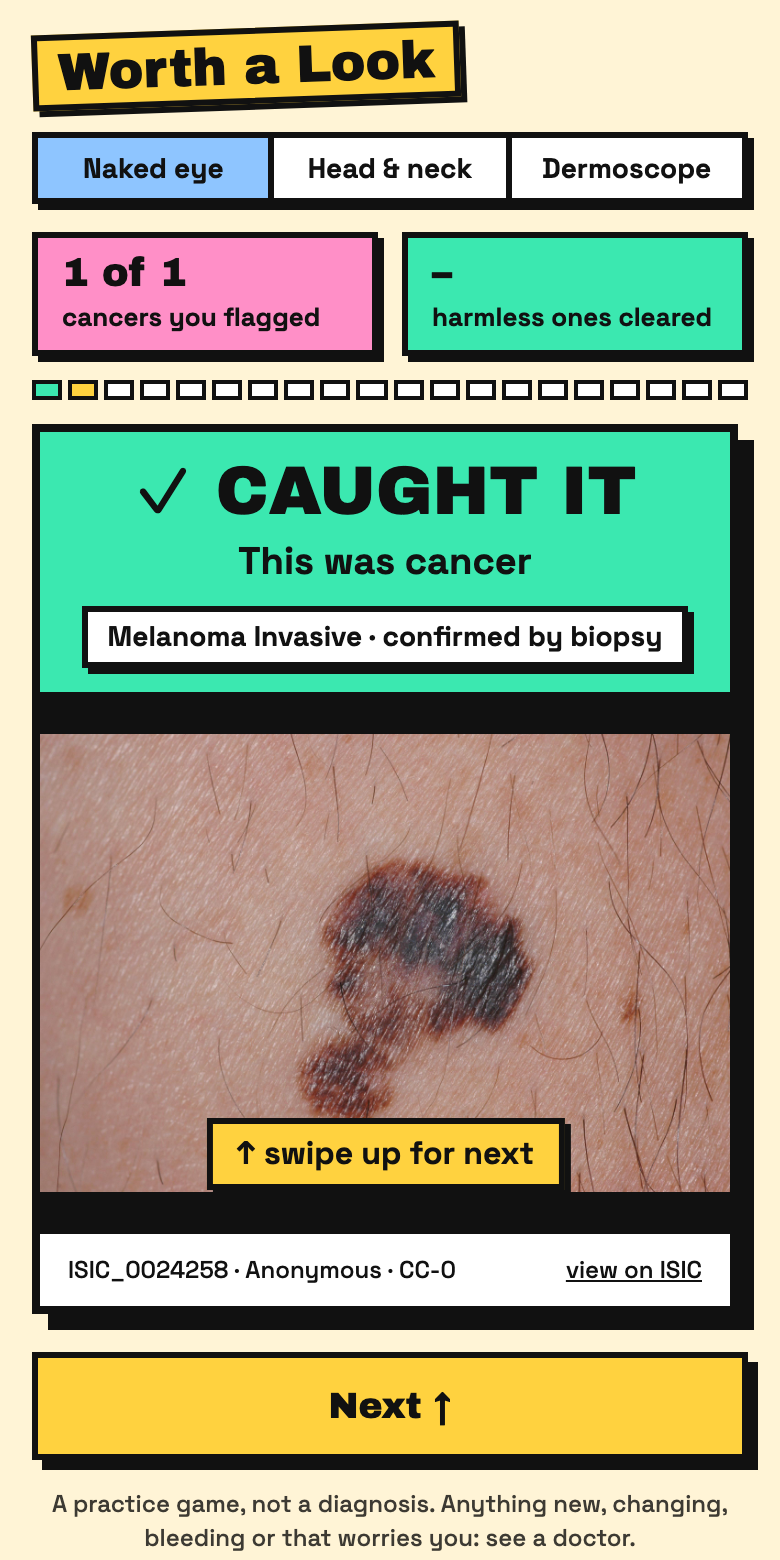
The answer appears with the diagnosis and, for common ones, what that diagnosis usually looks like. Every 20 photos you get a score. A separate 20-photo skill check shows how much you've improved.
Where the photos come from
Every photo comes from the ISIC Archive, a public collection of skin images run by the International Skin Imaging Collaboration. Every cancer in Worth a Look was confirmed by biopsy: a doctor removed the spot and a lab examined it under a microscope. So was almost every harmless spot. Everyday photos of harmless spots with a biopsy are scarce, so the game adds 406 that several dermatologists agreed were harmless from the photo, and each answer says which kind of check it had. Photos with no clear answer are left out, because there would be no answer to score you against.
Photos load straight from the archive into your browser. Each answer card shows the photo's ID, license and credit line, with a link to its page in the archive.
Naked eye
6,565 ordinary close-up photos, like one you'd take with a phone. This is the view you have of your own skin.
4,781 cancers and 1,784 harmless spots. Each round of 20 has 6 cancers.
Head & neck
The 2,085 everyday photos taken on the face, ears, neck and scalp. Built for barbers, hairdressers and estheticians, who see those places on other people every day.
After each cancer it shows a sentence you could say to a client.
Dermoscope
3,030 photos through a dermatoscope, the lit magnifier a skin doctor presses against the skin. Patterns show up that you can't see by eye.
1,503 cancers and 1,527 harmless spots.
Known gap: darker skin
Skin cancer can look different on darker skin, and this game can barely show it. Of its 9,595 photos, 94 are recorded as darker skin (types IV to VI on the Fitzpatrick scale dermatologists use): 37 cancers and 57 harmless spots. Those 37 are every darker-skin cancer photo in the archive. For most photos in the game, no skin type is recorded at all: only about 1 in 8 has one.
To make the most of them, Worth a Look deals those 94 photos about 1 time in 5, instead of fewer than 1 in 100. They repeat sooner as a result.
of the 106,950 images in 21 public skin cancer datasets had a skin type recorded at all. Most datasets came from Europe, North America and Oceania, and darker skin was substantially under-represented.
Wen et al., Lancet Digital Health, 2022for Black patients among 96,953 people with melanoma in the US, who were also more often diagnosed at a later stage.
Dawes et al., Journal of the American Academy of Dermatology, 2016AI models and dermatologists both did worse on photos of darker skin. Training on a diverse set of photos closed the gap for the AI.
Daneshjou et al., Science Advances, 2022Public photo collections mostly come from places where most patients have lighter skin. Some of the collections that do show darker skin are locked for research use. Stanford's Diverse Dermatology Images, 656 biopsy-confirmed photos across all skin tones, is one of them, and its license doesn't allow public display.
Why not use more of what the archive has? It holds about 2,400 more photos of harmless spots on darker skin. Almost all of them were called harmless by one clinician looking at the spot, with no biopsy and no second opinion. Every other photo in the game was confirmed by a biopsy or a panel of dermatologists, and a wrong "harmless" label teaches players to clear a spot that should have been checked. They also wouldn't fix the real gap, which is the 37 cancers. The full numbers and the options are written up here.
Opening collections like these for free education would let anyone learn to spot cancer on every skin tone. If you run one, or can help open one, please get in touch.
What it can't do
- It can't tell you about your own skin. It's a practice game. Anything new, changing, bleeding or worrying you should be seen by a doctor, whatever your score says.
- 6 in every 20 photos are cancer. In real life almost every spot is harmless. Rounds lean harmless so every mole doesn't start to look suspicious, while still giving enough practice on cancers.
- Most harmless photos are harder than real life. They were suspicious enough that a doctor took a biopsy. Your everyday moles look far more ordinary.
- Most naked-eye cancers are basal cell carcinoma, the most common skin cancer. Melanoma practice is stronger in dermoscope mode.
- Very few photos show darker skin. See Known gap: darker skin above.
Rights and licenses
The code
MIT license. Use it, change it and share it, as long as the copyright notice stays with it.
The photos
Each belongs to its contributor to the ISIC Archive, under CC0, CC BY or CC BY-NC. Every answer card credits the photo with its ISIC ID, contributor and license.
Non-commercial
Worth a Look is free, has no ads and will not be sold. Over half the photos only allow non-commercial use.
No accounts, cookies or analytics. Your score stays in your browser, and the fonts are bundled, so the only outside requests are for the photos. The full details, including how to ask for a photo to be removed, are in RIGHTS.md.
Run it yourself
It's a static web page with a small Node server. No build step, no database.
git clone https://github.com/jaredpeters/worth-a-look.git
cd worth-a-look
npm install
npm start            # open http://localhost:8140
Or with Docker: docker compose up -d.
The list of photos ships with the repo. To fetch a fresh copy from the archive, run
python3 scripts/build_deck.py. It takes a few minutes and uses only the Python standard library.